
Buying a skate helmet for a child can be confusing. I am a skateboarder and a dad. My son James has used Triple Eight and Nutease helmets while learning to skate. We still use both.

I can speak most clearly about the helmets we have used. I also looked at current youth helmets from Pro-Tec and S1. We have not used those two helmets for a long time, so I list them as other options, not as fully tested picks.
For skateboarding, I first look for ASTM F1492. Fit also matters. A helmet should sit level and feel snug. MIPS can be an extra feature, but it does not replace a good fit or the right safety standard.
No helmet can stop every injury. The goal is to choose the right helmet, make sure it fits, and use it every time.
Quick Picks
Our long-term pick: Triple Eight THE Certified Sweatsaver Helmet. This is the helmet we know best from real use.
Another helmet we use: Nutease Multi-Sport Helmet. We still use it, but I can no longer find it for sale in the U.S.
Current alternatives: Pro-Tec JR. Classic Fit Certified and S1 Mini Lifer. We researched these models, but we have not used them long-term.
| Helmet | Our experience | Best for | Current fit info | Skate standard |
|---|---|---|---|---|
| THE Certified Sweatsaver — Tony Hawk Signature Edition | Young kids & beginners | 49–52 cm (XS) / 52–56 cm (S) | CPSC, ASTM F1492 | $45–$55 |
| Nutease Multi-Sport | Young kids & beginners | 49–52 cm (XS) / 52–56 cm (S) | CPSC, ASTM F1492 | $45–$55 |
| Pro-Tec Classic Junior | All-around skating | XS: 47–49 cm / S: 49–51 cm / M: 51–53 cm | CPSC, ASTM F1492 | $40–$50 |
| S1 Mini Lifer | Maximum protection | XXS–L (46–56 cm, multiple liners) | CPSC, ASTM F1492 | $60–$70 |
Triple Eight THE Certified Sweatsaver Helmet – Our Long-Term Pick
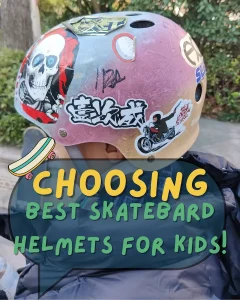
This is the helmet I can talk about with the most confidence. James has used a Triple Eight helmet for 5 years. He has worn it at skateparks, in bowls, and while learning new tricks.
I have seen the helmet touch a ledge or the ground during real falls. One time, James hit the edge of a ledge during a 50-50. He has also hit a nearby pillar after an ollie and fallen backward in a bowl. He was not hurt in the falls I describe here. I cannot say what would have happened without the helmet.
What matters most to me is that James will wear it. The helmet fits him well, and we can adjust it so it stays snug. The soft, thick pads feel comfortable and help keep the helmet from moving around on his head. It also has good airflow, so it does not feel too hot when he skates. The padding makes the helmet feel secure and comfortable, which is important for long skate sessions.
The current Triple Eight THE Certified Sweatsaver Helmet is made for head sizes from 46 to 52 cm. It uses an ABS outer shell, an EPS liner, soft fit pads, and an adjustable fit dial. Triple Eight lists both ASTM F1492 and the U.S. CPSC bicycle helmet standard for this model.
Pros / Limits
| What we like | Limits/what to check |
|---|---|
| We have real long-term use with it | It only works if the head size fits the model range. |
| Simple fit system. | Do not call it “the safest” without comparative test data. |
| Soft pads can help comfort. | Check the current label and maker size chart before buying. |
Another Helmet We Use: Nutease Multi-Sport Helmet
James still uses our Nutease helmet from time to time. We have used it along with the Triple Eight helmet, so I can compare how the two helmets feel and fit in real life.
I can no longer find this Nutease model for sale in the U.S. Because of that, I do not list it as a current buying pick. I still include it because it is part of our real experience.
Our Nutease helmet has a MIPS system. You can see the low-friction layer inside the helmet. The inside looks different from our Triple Eight helmet, and the soft pads do not look as thick.
At first, I thought the thick soft pads were the main part that protected the head. That is not quite right. Soft pads mainly help with fit and comfort. The impact liner under the pads does much of the work during a hit. MIPS adds another layer that is made to move a small amount in some angled impacts.
MIPS vs. a Helmet Without MIPS: What Is Different?
Both helmet types use the same basic idea. They have a hard outer shell, an impact liner, and pads that help the helmet fit.
A MIPS helmet adds a low-friction layer inside the helmet. In some angled hits, this layer can let the helmet move a small amount around the head. MIPS says this movement can be about 10 to 15 mm. The goal is to reduce some rotational motion.
MIPS is not a safety standard. It is an extra helmet system. A MIPS logo does not replace ASTM F1492. I would first choose a helmet that fits well and meets the right skate standard. Then I would look at extra features such as MIPS.
Independent lab studies on bicycle helmets have found lower rotational head motion in some angled impact tests with MIPS. The size of the effect changes by helmet and test. These results do not give a guaranteed number for skateboarding.
| Feature | Certified helmet without MIPS | MIPS-equipped helmet |
|---|---|---|
| Hard outer shell | Yes | Yes |
| Impact liner such as EPS | Yes | Yes |
| Soft comfort / fit pads | Usually | Usually |
| Extra low-friction layer | No MIPS layer | Yes |
| Main extra goal | No dedicated MIPS layer | Manage some rotational motion in certain angled impacts |
| Safety standard | Check ASTM F1492 | Still Check ASTM F1492 |
| Fit | Very important | Very important |
| Price | Often lower | Often higher |
| What it does not mean | Not “unsafe” just because it lacks MIPS | Not automatically “safer than every nonMIPS helmet” |
Personal observation
When I put our two helmets side by side, the biggest difference I notice is inside. The Triple Eight
has thick soft pads. The Nutease MIPS helmet looks more mechanical inside because of the
moving layer. The two designs feel different, but pad thickness alone does not tell us how much
impact protection a helmet has.
Pro-Tec JR. Classic Fit Certified – A Current Alternative
We have not used this helmet long-term. I include it as a current option because Pro-Tec gives clear youth sizing and current safety information for the model.
Pro-Tec lists two youth sizes that cover head sizes from 47 to 56 cm. The helmet has an ABS shell, an EPS liner, 11 vents, a Twist Fit system, and two sets of comfort liners. Pro-Tec also lists ASTM F1492 and the U.S. CPSC bicycle helmet standard.
This model may be worth a look if your child needs a wider youth size range than the Triple Eight THE Certified Sweatsaver Helmet. Check the current Pro-Tec size chart before you buy.
S1 Mini Lifer – A Deep-Fit Alternative
We have not used the S1 Mini Lifer long-term. I include it because S1 gives clear skate and bike certification information and uses a deep-fit design with replaceable sizing liners.
S1 lists an EPS-based impact liner and ASTM F1492 skate testing for the Mini Lifer. It also lists the U.S. CPSC bicycle helmet standard. The helmet uses different liners to change the fit inside the shell.
This may be a good option to compare if you want a deeper fit or a liner-based fit system. Use S1’s current size chart to choose the right liner and shell
How to Measure Your Child’s Head
Step-by-step
- Use a soft tape measure.
- Wrap it around the widest part of the head.
- Keep the tape level. Do not pull it too tight.
- Measure two times.
- Use the helmet maker’s current size chart.
Quick Helmet Fit Check
The helmet should sit level on the head. It should not tilt far back.
The front edge should sit about one or two finger widths above the eyebrows.
The side straps should make a V under each ear
The chin strap should feel snug, but it should not hurt.
Ask your child to move the head gently. The helmet should not slide around.
ASTM F1492 vs. CPSC: What Parents Should Know
ASTM F1492
ASTM F1492 is a helmet standard used for skateboarding and trick roller skating. The U.S. CPSC helmet guide lists ASTM F1492 for skateboarding.
CPSC
CPSC 16 CFR 1203 is the U.S. federal bicycle helmet standard. A helmet made only for skateboarding is not covered by the bicycle helmet rule.
A helmet that meets both standards can be useful for a child who skates and also rides a bike. But “dual certified” does not mean it is the safest helmet for every child. Fit still matters.
| Certification | What It Means | Impact Protection | Best Use |
|---|---|---|---|
| CPSC | Mandatory U.S. safety standard for bicycle and skate helmets | High-impact, single crash protection | Biking, single serious falls |
| ASTM F1492 | Voluntary standard focused on skateboarding & roller sports | Multiple smaller impacts, protects against repeated falls | Skateboarding, inline skating, scootering |
Frequently Asked Questions (FAQ)
1. What safety standard should I look for in a skateboard helmet?
For skateboarding, I look for ASTM F1492 first. If the child also rides a bike, a helmet that also meets the U.S. CPSC bicycle helmet standard can be useful.
2. Is MIPS the same as a safety certification?
No. MIPS is an extra system inside some helmets. It is made to help manage some rotational motion in certain angled impacts. You should still check the helmet’s safety standard and fit.
3. Can my child use a bike helmet for skateboarding?
Check the label. A bike-only helmet may meet the CPSC bicycle standard but not ASTM F1492. For skateboarding, I prefer a helmet that lists a skate-related standard such as ASTM F1492.
4. How do I choose the right size?
Measure the head with a soft tape. Then use the current size chart from the helmet maker. Do not choose by age alone.
5. When should I replace a child’s helmet?
Follow the helmet maker’s instructions. Replace a helmet if the maker says to replace it after an impact, if it is damaged, or if it no longer fits. Some damage can be hard to see.
Conclusion
If your child fits our Triple Eight model, it is the helmet I can talk about with the most confidence because James has used it for a long time.
We also still use a Nutease MIPS helmet, but I can no longer find our model for sale in the U.S. I keep it in this guide because it gives us real experience with a different helmet design.
Pro-Tec and S1 are current options worth comparing. We have not used those two helmets longterm, so I treat them as researched alternatives.
Whichever helmet you choose, measure the head first. Check the current size chart and skate standard. Then make sure the helmet sits level and snug.

3 thoughts on “Best Skateboard Helmets for Kids & Youth: Fit & Safety Guide”
Your article helped me a lot, is there any more related content? Thanks!
I don’t think the title of your article matches the content lol. Just kidding, mainly because I had some doubts after reading the article.
Great article! I really appreciate how clearly you explained the essential safety standards and fitting guidelines for children’s helmets—this makes choosing the right protection so much easier for parents.
A great addition to this guide would be a quick checklist or visual sizing chart that parents can easily reference or save before buying.
Also, do you have any specific recommendations on when a helmet should be replaced after a minor fall, even if there is no visible external damage? Thanks for sharing!